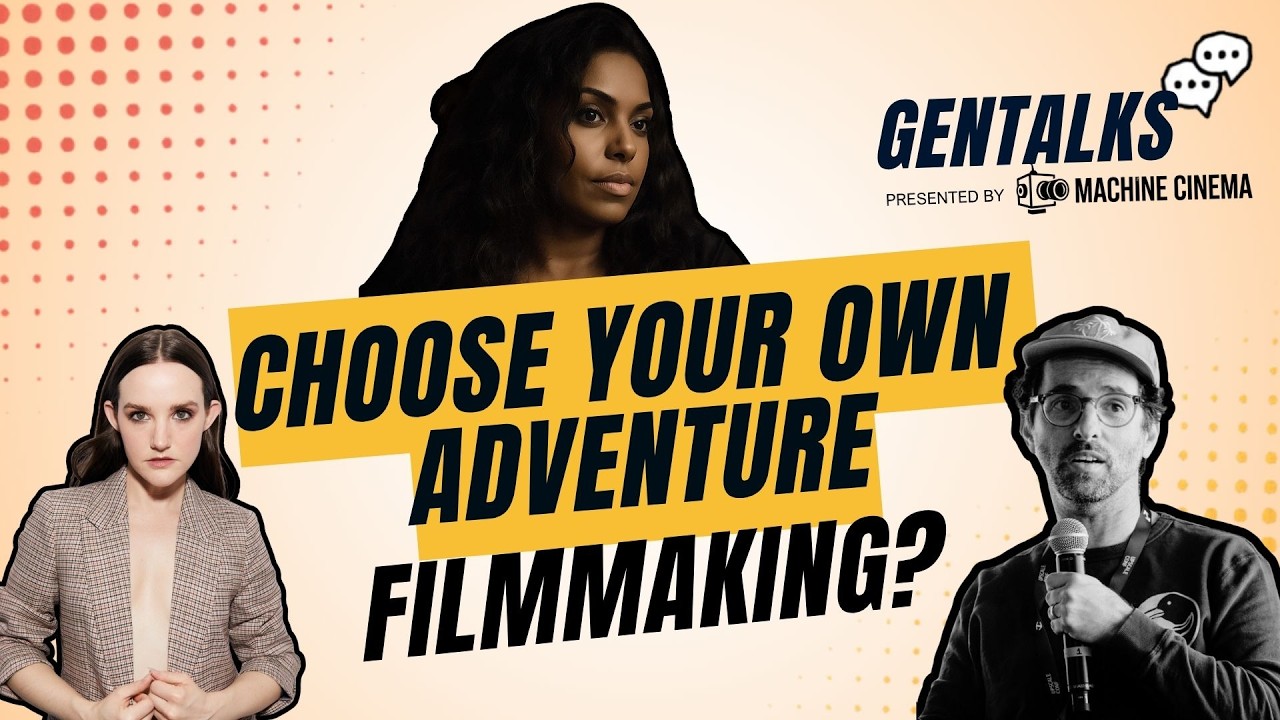
AI Video, Interactive Storytelling, and the New Creator Workflow Fred, Jagger Waters, and Afro Futcha break down a packed week in AI video, from Gemini’s video updates to MiniMax H3 and the growing idea of generations that render faster than you can watch them. They also dig into what happens when storytelling becomes interactive, how creators are using tools like InVideo and ChatGPT in real workflows, and why distribution still decides whether a finished project actually reaches an audience. Key topics In this episode, Fred and Jagger discuss Gemini’s video update, especially scene extension and the ability to analyze up to 10 seconds of prior context instead of only the final second. They compare today’s video tools with early Runway extensions, noting how much better the newer models preserve motion, physics, and continuity. The conversation turns to the “Adobe for video” moment, with Fred arguing that Google is pushing hard into the editing layer, not just generation. Jagger highlights MiniMax H3 and the Foul Live experiment, where generations can be produced faster than playback, making real-time, branching content possible. They discuss how audience voting can shape narrative in live AI storytelling, including the tension between passive consumption and participatory viewing. Fred and Jagger frame this as a modern version of long-running fan culture, referencing worldbuilding, comment-thread communities, Roblox, Minecraft, The Sims, and Neopets as earlier forms of co-creation. Jagger’s creator crush is Heavy Pulp, whose work stands out for a strong visual identity, a clear public profile, and the short film Peyote, which he praises for emotional arc and cinematic consistency. The episode also covers Coyote vs. Acme as a case study in distribution, shelving, and how a finished creative work can still get blocked by industry decisions. Afro Futcha joins to discuss Six Minutes, a film that began as a spontaneous experiment after C2.5 arrived and quickly grew into a 43-minute project. Afro Futcha explains her workflow: generating in short bursts, building the story in public, writing educational breakdowns, and using character sheets and assets to avoid excessive generation. She walks through her InVideo setup, where different agents act like a director of photography, videographer, writer, sound person, and assistant, each handling different creative tasks. She also talks about voice consistency, including cloning her own voice and adjusting character delivery when a monotone performance flattened the emotional range. Afro Futcha closes by shouting out Tasha Colefields, whose upcoming Muhammad Ali project impressed her for its research depth, patience, and focus on meaningful storytelling. Timestamps 00:00 - Opening the AI video conversation 01:29 - Gemini video extension and longer context awareness 02:16 - How video tools preserve motion and continuity better now 03:07 - Draft mode, higher resolution, and faster iteration 04:34 - MiniMax H3 and the “faster than playback” breakthrough 05:28 - Foul Live and live branching channels 06:05 - Interactive filmmaking as a real-time audience experience 07:03 - The “Will Smith spaghetti” lesson about tools that improve fast 08:34 - Building new filmmaker identities with vibe-coded tools 09:41 - The limits of choose-your-own-adventure storytelling 10:36 - Why fan fiction, Roblox, and Minecraft matter here 11:56 - Coyote vs. Acme and the cost of shelving finished work 16:51 - Heavy Pulp as a creator crush 17:35 - Why Peyote stands out as a visual poem 20:35 - Introducing Afro Futcha and Six Minutes 26:40 - How Six Minutes started as a 30-second experiment 28:53 - Turning short outputs into a 43-minute film 29:52 - Thinking in pieces instead of the whole film 31:49 - Building audience energy around work in progress 33:33 - Using her own likeness and acting background 34:39 - Voice cloning and fixing flat delivery 36:19 - InVideo as a multi-agent production system 39:25 - Different agents for DOP, videography, sound, and cleanup 42:44 - Using ChatGPT alongside InVideo for script and story work 44:39 - Tasha Colefields and the Muhammad Ali project 48:18 - Parts work, identity, and the human side of AI tools 49:17 - AI making Jagger feel more human, not more robotic 49:46 - Afro Futcha on offloading cognitive load and “touching grass” Notable quotes Copy “I’m becoming more human because of AI.” Copy “We can do 30 second generations. It doesn’t mean anything. You still need to edit the hell out of all of the generations.” Copy “I’ve always been a robot.”